
For many small business owners, tax season can be stressful.
Incomplete records, improperly categorized expenses, missing documentation, and unreconciled accounts complicate tax preparation.
Good bookkeeping streamlines the process.
The good news is that tax preparation starts with good bookkeeping.
Maintaining accurate financial records throughout the year supports clear reporting for business owners.
This bookkeeping provides the tax professional with the information needed to prepare an accurate return.
If you manage your own books, or use a professional bookkeeping service, several key metrics matter. Additionally, they should be monitored throughout the year.
1. Track Business Revenue Accurately
One of the most important aspects of small business bookkeeping is maintaining accurate records of business income.
Your bookkeeping system should provide a clear picture of:
- Monthly revenue
- Year-to-date revenue
- Revenue by customer or service, when appropriate
- Outstanding accounts receivable
- Deposits and other sources of business income
Regularly reconciling revenue to your bank accounts and other financial records can help identify missing transactions or discrepancies before they become a year-end problem.
Accurate revenue reporting is also essential when preparing business tax returns.
2. Monitor Business Expenses by Category
Knowing how much a business spends is important. Knowing where the money is being spent is even more valuable.
A good bookkeeping system should accurately categorize business expenses, including:
- Payroll
- Advertising and marketing
- Insurance
- Professional services
- Office supplies
- Software and technology
- Rent and utilities
- Travel
- Vehicle expenses
- Business meals
- Bank and credit card fees
Accurate expense categorization helps business owners understand their operating costs and provides better information to their tax professional when determining which expenses may qualify as tax deductions.
Poorly categorized expenses can create additional work during tax preparation and may result in important information being overlooked.
3. Keep Track of Owner Draws and Contributions
Owner transactions are another area where accurate bookkeeping is particularly important.
Depending on the type of business, money taken out of the business by an owner may be treated differently for accounting and tax purposes than an ordinary business expense.
Bookkeepers should properly identify and track:
- Owner draws
- Owner contributions
- Distributions
- Personal expenses paid through the business
- Transfers between business and personal accounts
Keeping these transactions separate from ordinary business income and expenses helps produce more accurate financial statements and gives the tax professional better information when preparing the business tax return.
4. Track Fixed Assets and Major Business Purchases
Major purchases deserve special attention in your bookkeeping records.
Businesses may purchase equipment, computers, furniture, vehicles, machinery, or other assets during the year. These purchases should be tracked separately rather than automatically being recorded as ordinary operating expenses.
Important information to maintain includes:
- Purchase date
- Purchase price
- Description of the asset
- Vendor
- Financing information
- Business-use information
Your tax professional can then determine the appropriate tax treatment, including whether depreciation or another available deduction may apply.
This is one reason year-round bookkeeping is so important. Trying to identify and reconstruct major asset purchases months after they occurred can be unnecessarily difficult.
5. Monitor Payroll and Contractor Payments
Payroll is often one of the largest expenses for a small business, making accurate payroll bookkeeping essential.
Bookkeepers should regularly reconcile payroll expenses and ensure that payroll transactions are properly recorded in the accounting system.
Businesses that work with independent contractors should also maintain organized records of contractor payments.
Keeping this information current throughout the year can make year-end bookkeeping and tax reporting significantly easier.
6. Reconcile Bank and Credit Card Accounts Regularly
Bank reconciliation is one of the most important bookkeeping tasks for maintaining accurate financial records.
Regular reconciliation helps identify:
- Missing transactions
- Duplicate transactions
- Incorrectly recorded amounts
- Unusual transactions
- Outstanding checks
- Bank fees
- Credit card activity that has not been properly recorded
Waiting until the end of the year to reconcile accounts can turn a manageable bookkeeping task into a significant cleanup project.
7. Review Financial Reports Throughout the Year
Tax preparation is only one reason to maintain accurate bookkeeping records.
Business owners should regularly review financial reports such as the Profit and Loss Statement and Balance Sheet to understand how their business is performing.
These reports can help answer important questions:
- Is revenue increasing or decreasing?
- Which expenses are growing?
- Are profit margins changing?
- Is the business generating enough cash?
- Are there unusual transactions that need attention?
- Are there areas where the business could reduce expenses?
This information can help business owners make better decisions throughout the year—not just when tax season arrives.
The Importance of Tax-Ready Bookkeeping
Good bookkeeping is about more than entering transactions into QuickBooks or producing a monthly Profit and Loss Statement.
Tax-ready bookkeeping means maintaining organized, accurate financial records throughout the year so that the business owner and tax professional have the information they need when tax filing time arrives.
A proactive bookkeeping process can help ensure that:
- Business income is accurately recorded
- Expenses are properly categorized
- Owner transactions are correctly identified
- Fixed assets are properly tracked
- Payroll and contractor payments are organized
- Bank and credit card accounts are reconciled
- Financial statements accurately reflect the business
The result is a business that is better prepared for tax filing and better equipped to make informed financial decisions throughout the year.
Don’t Wait Until Tax Season to Get Your Books in Order
One of the biggest bookkeeping mistakes a small business owner can make is waiting until tax season to find out whether their books are accurate.
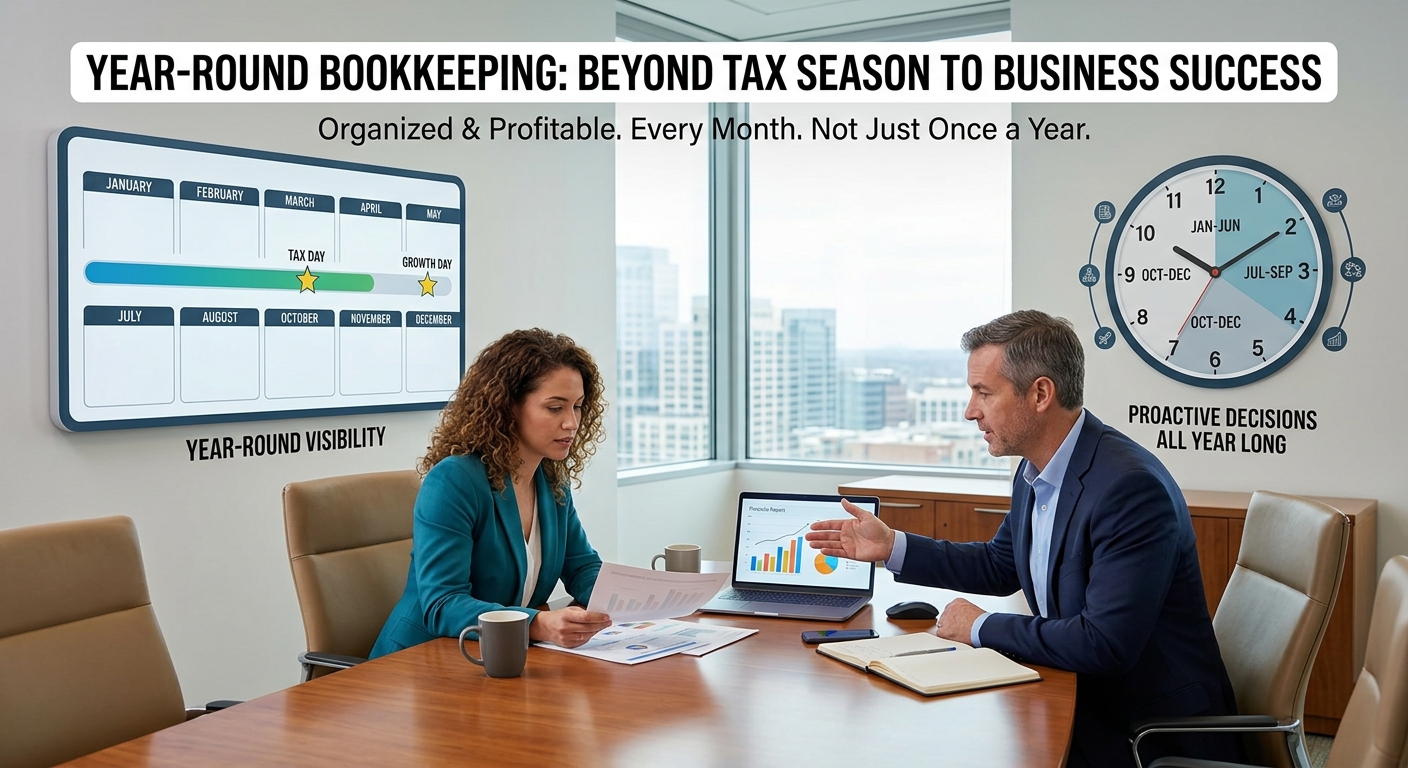
Tax preparation is a once-a-year event. Good bookkeeping is a year-round process.
Working with a professional bookkeeper can help keep your financial records organized, provide better visibility into your business finances, and make the transition from bookkeeping to tax preparation much smoother.
If your business books aren’t currently giving you the information you need, it may be time to take a closer look at your bookkeeping process. Contact us today for a free consultation.

